For most Kenyan students, pursuing higher education is a dream—but financial challenges can make it difficult. That’s where the Higher Education Loans Board (HELB) comes in. Established in 1995, HELB provides affordable loans, bursaries, and scholarships to students in universities and TVET institutions across Kenya.
If you are a first-time applicant, the process can seem overwhelming—forms, guarantors, deadlines, and online registration. But don’t worry. This article will walk you through how to apply for a HELB loan step by step, while also covering eligibility, requirements, repayment, and common mistakes to avoid.
Related: Best Survey Sites To Make Money Online In Kenya: Complete Guide 2025
Check: Free hashtag generator tool
What is HELB?
The Higher Education Loans Board (HELB) is a government agency that finances higher education for Kenyan students. Its mission is to increase access to education by providing affordable student loans that are repaid after graduation.
HELB offers three main financial aid products:
- Undergraduate Loans – for students pursuing degree or diploma courses.
- TVET Loans and Bursaries – for students in Technical and Vocational Education and Training institutions.
- Postgraduate Loans – for Master’s and PhD students.
Related: Triaba Kenya Review: Everything You Need to Know Before Joining
Check: Youtube name generator
Who is Eligible for HELB Loan?
Before applying, ensure you meet these basic requirements:
- You must be a Kenyan citizen.
- You must be enrolled in a recognized university or TVET institution in Kenya (public or private).
- For undergraduate first-time applicants, you should be a direct entry student from high school (KUCCPS placement) or a continuing student.
- You must be at least 18 years old.
- You must have the necessary supporting documents (ID, admission letter, guarantors’ info, etc.).
HELB Loan Application Requirements
Here are the key documents you’ll need when applying for a HELB loan (first-time application):
- National ID Card (both sides scanned).
- Admission letter from your university or TVET institution.
- KCSE result slip or certificate.
- Parents’ or guardians’ ID copies.
- Guarantors’ ID copies (two required).
- Bank account details (Co-operative Bank or KCB recommended).
- KRA PIN Certificate (for both student and parents/guardians).
- Passport-size photo (recent).
For subsequent HELB applications (continuing students), you only need to apply online—no physical forms are required.
Check: Business name generator
Step by Step Guide: How to Apply for HELB Loan
Step 1: Register for a HELB Account on the Portal
- Visit the HELB Student Portal.
- Click on Register as a new applicant.
- Provide your ID number, first name, and email address.
- Create a strong password and confirm registration.
- Log in to your account using the credentials.
💡 Tip: Use an email and phone number you will always have access to during your academic years.
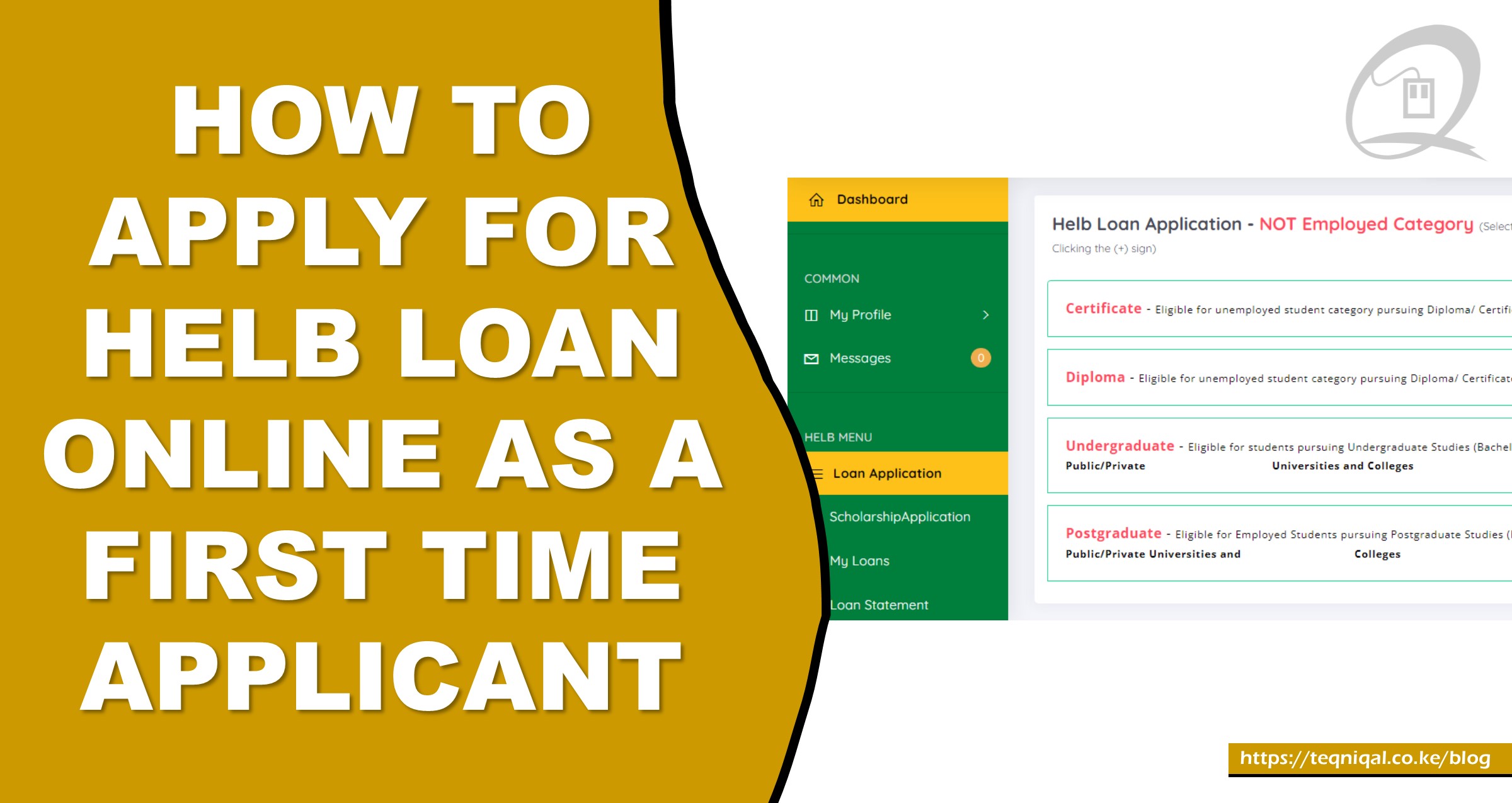
Step 2: Access the HELB Loan Application Form
- Once logged in, go to Loan Application Menu.
- Select the correct loan type: First Time Undergraduate, TVET, or Postgraduate.
- Read the instructions carefully before proceeding.
Step 3: Fill in Personal and Academic Details
- Enter your personal information (ID, date of birth, contacts).
- Provide your parent/guardian details (occupation, income, contacts).
- Add details of your two guarantors (must be employed and have Kenyan ID numbers).
- Fill in your academic details (institution name, admission number, course, year of study).
💡 Be truthful in all details—false information can lead to rejection or legal action.
Step 4: Upload Required Documents
Scan and upload clear copies of:
- National ID (both sides).
- Admission letter.
- KCSE certificate.
- KRA PIN.
- Parents’/guardians’ IDs.
- Guarantors’ IDs.
- Passport photo.
All uploads must be in PDF format and within the required file size.
Step 5: Print the HELB Loan Application Form
After completing the online form:
- Download and print the HELB Loan Application Form (LAF).
- Attach all required documents.
- Have the form signed and stamped by:
- Guarantors
- Your local chief
- Religious leader or magistrate (optional, depending on updates)
- Commissioner of Oaths/Advocate (mandatory)
💡 This physical form is only required for first-time applicants.
Step 6: Submit the HELB Form
- Drop the completed form at HELB offices in Nairobi (Anniversary Towers, 19th Floor).
- Alternatively, submit at select Huduma Centres across Kenya.
- Always keep a copy of the signed form for your records.
Step 7: Wait for Processing and Allocation
HELB will review your application and allocate funds based on:
- Family financial background.
- Academic institution.
- Government budget.
Once approved, your loan status will change to Disbursed in your student portal.
Check: Free Grammar checker tool
How Much Does HELB Loan Pay?
The loan amount varies depending on your financial need and available budget.
- Minimum allocation: Ksh 35,000 per year.
- Maximum allocation: Ksh 60,000 per year.
The money is usually divided into two:
- Tuition fees (sent directly to your institution).
- Upkeep allowance (sent to your bank account).
Check: image compressor tool
How to Check HELB Loan Status
- Log into the HELB Student Portal.
- Click on Loan Status.
- You’ll see whether your loan is Submitted, Processing, Approved, or Disbursed.
You can also check via HELB Mobile App or USSD Code *642#.
Check: side hustle idea generator
HELB Loan Repayment
Repayment begins one year after graduation or upon securing employment—whichever comes first.
- Repayment methods include:
- M-Pesa Paybill 200800
- Bank deposit (Co-op Bank, KCB, Equity, Family Bank)
- Direct employer deductions
💡 Early repayment attracts discounts of up to 15%.
Common Mistakes Students Make When Applying
- Using fake guarantors or incorrect ID numbers.
- Forgetting to attach documents.
- Missing the deadline (usually July–October for first-time applications).
- Using a parent without a KRA PIN.
- Entering the wrong bank account details.
Tips to Increase Chances of Loan Approval
- Fill the form truthfully and completely.
- Choose reliable guarantors who can be reached if needed.
- Submit your form early (avoid last-minute rush).
- Keep copies of all documents submitted.
- Regularly check your loan status online.
HELB Alternatives for Students
If HELB doesn’t meet your financial needs, consider:
- County government bursaries.
- Constituency Development Fund (CDF) bursaries.
- NGO and private scholarships (e.g., Equity Bank Wings to Fly, KCB Foundation).
- Work-study programs within your university.
Check: Text to speech tool
Final Thoughts
The HELB loan has supported millions of Kenyan students to achieve their education dreams. While the application process may seem tedious at first, following the steps carefully ensures a smooth experience.
Remember:
- Gather your documents early.
- Fill the form accurately.
- Submit before the deadline.
With this step-by-step guide, you now know exactly how to apply for HELB loan in Kenya without confusion.
Education is an investment, and HELB remains one of the most accessible financing options for Kenyan students. Use it wisely, and plan for repayment to ensure future generations also benefit.