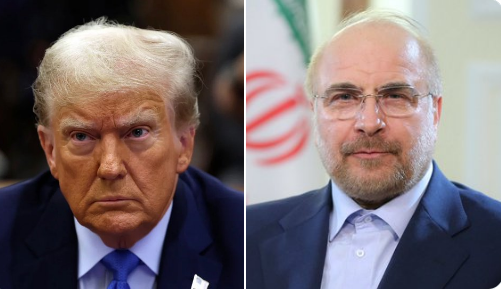
US President Donald Trump has been holding direct talks with Iran’s Parliament Speaker, Bagher Ghalibaf, on ending the war in Iran and reopening the strategic Strait of Hormuz, according to White House officials.
The negotiations are taking place in Pakistan and have reached an advanced stage, officials familiar with the matter confirmed.
Why These Talks Matter
The discussions mark a significant diplomatic shift, bringing together Trump and Ghalibaf—a powerful figure in Iran’s political establishment who has long been seen as a potential successor to Supreme Leader Ali Khamenei.
The Strait of Hormuz, a narrow waterway between Iran and Oman, is the world’s most critical oil transit chokepoint. Nearly 20% of global petroleum passes through it daily. Iran has repeatedly threatened to close the Strait in response to military action or sanctions, a move that would send global oil prices soaring and trigger an immediate economic crisis.
Who Is Bagher Ghalibaf
Bagher Ghalibaf is one of the most influential figures in Iran’s political and military establishment. Born in 1961 in Mashhad, he has held some of the most powerful positions in the Islamic Republic over the past three decades.
Military Career
Ghalibaf began his career in the Revolutionary Guard during the Iran-Iraq war (1980–1988), where he rose through the ranks as a commander. His wartime record earned him a reputation as a disciplined, strategic operator. In 1996, Supreme Leader Ali Khamenei appointed him as the commander of the Revolutionary Guard’s air force, a position he held until 2000. He later served as the chief of police forces from 2000 to 2005, where he gained a reputation for cracking down on street crime and modernising Iran’s law enforcement apparatus.
Political Career
Ghalibaf has run for president three times—in 2005, 2013, and 2017—positioning himself as a pragmatic conservative focused on economic reform and administrative efficiency. Although he lost each time, his consistent showing solidified his status as a heavyweight in Iranian politics.
From 2005 to 2017, he served as the mayor of Tehran. During his tenure, he oversaw large-scale infrastructure projects, including highways, metro expansions, and urban development initiatives. Supporters credit him with transforming Tehran’s transport system; critics accuse him of corruption and mismanagement, allegations he has consistently denied.
In 2020, Ghalibaf was elected as the Speaker of Iran’s Parliament (Majlis), a position he still holds. As Speaker, he has balanced loyalty to the Supreme Leader with occasional pragmatic criticism of the government’s handling of the economy. He was widely regarded as a potential candidate for Supreme Leader after Khamenei, whose age and health made succession a central question in Iranian politics.
Why He Matters in These Talks
Ghalibaf’s involvement in direct negotiations with Trump is significant for several reasons:
- He had the Supreme Leader’s trust. The Guardian Council vets the Parliament Speaker, who operated with Khamenei’s approval, unlike Iran’s elected president. Ghalibaf would not be negotiating without Khamenei’s blessing.
- He is a pragmatist. His background as a military commander and urban administrator means he prioritises results over ideology. He has previously argued that Iran’s survival depends on economic stability, not endless confrontation with the West.
- He is a potential future Supreme Leader. Any deal Ghalibaf helps broker would strengthen his standing in the succession race, giving him a powerful incentive to deliver a tangible outcome.
What White House Officials Are Saying
White House officials described the talks as “advanced” but declined to share details on the proposed framework for ending the conflict.
“The discussions are ongoing. Both sides have shown genuine willingness to de-escalate,” a senior administration official said on condition of anonymity.
Pakistan is hosting the negotiations, positioning itself as a key mediator between Washington and Tehran. The country has maintained diplomatic channels with both nations despite regional tensions.
What a Successful Deal Would Mean
If successful, the agreement would:
- End the current phase of military confrontation between US-aligned forces and Iran-backed groups across the Middle East
- Reopen the Strait of Hormuz to full commercial shipping
- Potentially ease sanctions on Iranian oil exports in exchange for nuclear program concessions
- Reduce the risk of a wider regional war that has threatened to draw in multiple countries
Regional Context
The development comes as global powers have struggled for months to contain the spillover effects of the Israel-Hamas war, which has drawn in Iran-backed Hezbollah in Lebanon and Houthi rebels in Yemen. Attacks on commercial shipping in the Red Sea and Gulf of Aden have disrupted global trade routes.
Any agreement that stabilizes the Strait of Hormuz would ease supply chain pressures and lower oil prices—a priority for Trump as he faces re-election pressure over the cost of living.
What Happens Next
Neither the White House nor Iran’s mission to the United Nations has released an official statement. However, diplomatic sources in Islamabad confirmed that a third round of talks concluded earlier this week, with a fourth round scheduled.
The outcome remains uncertain. Hardliners in both Washington and Tehran oppose direct engagement. But the fact that talks are happening at this level—and have reached an advanced stage—signals that both sides see an off-ramp from a conflict that neither can afford to escalate further.
Read More from CityNews Kenya:
- Trump Hits on Turning to Cuba After Iran, “It’s Only a Question of Time
- Trump Says he Must be Involved in Choosing Iran’s Next Supreme Leader, Opposes The Appointment of The Late Ali Khamenei’s Son,” He is a Lightweight”
- Donald Trump Slams Obama, Says he Got Nobel Peace Prize For Doing Nothing But Destroying America
- “An Attack on Qatar Is an Attack on the United States,” Trump Declares in Executive Order
- Trump Blasts Western Countries For Recognising Palestine State, Says It Is A Big Win For Hamas Terrorists