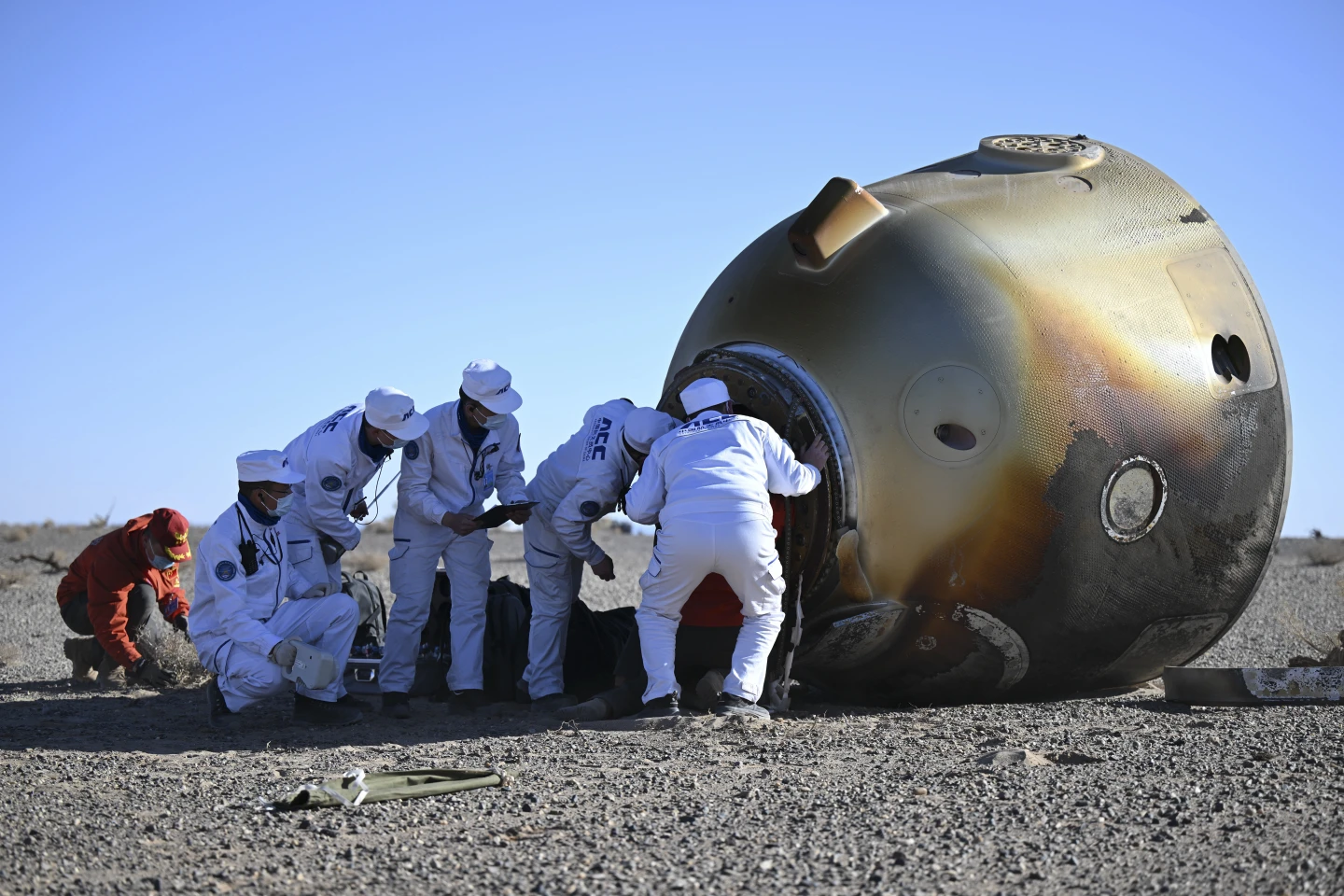
The Shenzhou-21 crew—who survived a spacecraft crisis, a near-stranding in orbit, and broke Chinese spacewalk records — are finally heading home in a capsule they never launched in.
WATCH: Shenzhou-21 return capsule descends under parachutes to Dongfeng landing site, Inner Mongolia. | Video: CCTV / CMSA
Three Chinese astronauts are set to return to Earth after completing one of the most dramatic and eventful missions in the history of China’s space programme. Commander Zhang Lu, Flight Engineer Wu Fei, and Payload Specialist Zhang Hongzhang — who have spent nearly seven months living and working aboard China’s Tiangong space station — are preparing to undock and begin their fiery descent back through the atmosphere, touching down at the Dongfeng landing site in Inner Mongolia.
Their mission, which began on October 31, 2025, was supposed to be a routine six-month crew rotation. Instead, it turned into one of the most complex rescue-and-recovery operations in Chinese spaceflight history — one that captivated space watchers around the world and raised urgent questions about spacecraft safety in an era of growing space debris.
The Crew
Commander Zhang Lu (张陆) — 2nd spaceflight. Veteran of the Shenzhou-15 mission (2022–23). Now holds the Chinese record for most spacewalks — seven total. Born in 1976 in Hunan Province, a former PLA Air Force senior colonel.
Flight Engineer Wu Fei (武飞) — 1st spaceflight. A ‘post-90s’ taikonaut born in 1993 in Inner Mongolia. A former aerospace engineer was selected into the taikonaut programme in 2020. Conducted two spacewalks on this mission.
Payload Specialist Zhang Hongzhang (张洪章) — 1st spaceflight. Science specialist responsible for managing Tiangong’s extensive research programme, supporting his crewmates during all three series of spacewalks.
How a Piece of Space Junk Changed Everything
On November 5, 2025—just days after the Shenzhou-21 crew arrived at Tiangong—mission controllers discovered a serious problem with the spacecraft the outgoing Shenzhou-20 crew was preparing to use for their journey home. A suspected piece of space debris had struck the Shenzhou-20 capsule, leaving cracks in the viewport window just hours before their planned departure.
China’s space agency made an extraordinary decision: rather than risk the damaged spacecraft, the Shenzhou-20 crew would return to Earth using the freshly docked Shenzhou-21 capsule—the very ship that Zhang Lu and his colleagues had just arrived in. The three Shenzhou-20 astronauts, Chen Dong, Chen Zhongrui, and Wang Jie, landed safely in the Gobi Desert on November 14.
But that decision left the Shenzhou-21 crew in a deeply uncomfortable situation. For over a week, Zhang Lu, Wu Fei, and Zhang Hongzhang continued working aboard Tiangong while knowing that the only backup capsule docked to the station was the same damaged craft deemed too dangerous to use.
“I’m very glad that they got home — but it is a bit disconcerting that the replacement crew apparently does not have a vehicle to come back to Earth.”
— Victoria Samson, Secure World Foundation
China moved swiftly. On November 25, 2025, an unmanned Long March 2F rocket lifted off from Jiuquan Satellite Launch Centre carrying Shenzhou-22—an emergency ‘lifeboat’ packed with food, supplies, and a specially developed window-repair treatment. It docked with Tiangong within days, restoring the crew’s escape route and ending the tense international episode.
Seven Months of Science in the Sky
With the crisis resolved, the crew turned back to the work that brought them to orbit: operating China’s National Space Laboratory aboard the three-module Tiangong station, which orbits Earth between 340 and 450 kilometres above the surface.
Over the following months, they conducted dozens of experiments spanning space medicine, microgravity physics, materials science, and biology. They collected biological samples to study how long-duration spaceflight affects how the human body absorbs medication — data critical for future crewed missions to the Moon and Mars. They also tended a plant-growth project, coaxing flowers to bloom in weightlessness, and worked alongside Xiao Hang (小航), Tiangong’s robotic crewmate, testing autonomous flight and touch interaction that hint at how AI may partly staff future space stations.
A Record-Setting Spacewalker
Outside the station, Zhang Lu and Wu Fei completed three full series of spacewalks over the course of the mission. Their first outing in December 2025 included an inspection of the cracked Shenzhou-20 window. A second seven-hour spacewalk in March 2026 installed additional debris-protection shields on Tiangong’s hull.
The mission’s final spacewalk on April 16, 2026, lasted approximately five and a half hours. When Zhang Lu re-entered the station, he had completed his seventh EVA—a new Chinese record for the most spacewalks by any taikonaut in history.
Mission Timeline
31 October 2025 — Shenzhou-21 launches from Jiuquan. Crew docks with Tiangong in under four hours.
5 November 2025 — Space debris cracks Shenzhou-20’s viewport window hours before the crew’s planned return.
14 November 2025 — Shenzhou-20 crew return to Earth safely — in Shenzhou-21’s capsule, leaving the new crew without a return vehicle.
25 November 2025 — Emergency Shenzhou-22 capsule launches unmanned to Tiangong, restoring the crew’s return route.
9 December 2025 — First spacewalk: Zhang Lu and Wu Fei inspect and treat the cracked Shenzhou-20 window.
19 January 2026 — The repaired Shenzhou-20 capsule returns to Earth empty, carrying cargo.
16 March 2026 — Second EVA series: seven-hour spacewalk installs debris-protection hardware.
16–17 April 2026 — Third EVA: Zhang Lu completes his 7th spacewalk, setting a new Chinese record. Mission extended by one month.
24 April 2026 — Crew celebrates China Space Day in orbit.
Late April / May 2026 — Shenzhou-21 crew return to Earth aboard Shenzhou-22, landing at Dongfeng in Inner Mongolia.
Returning in a Ship They Never Flew In
In a fitting bookend to a mission full of surprises, the Shenzhou-21 crew will make their journey home not in the capsule they launched in but in Shenzhou-22—the emergency lifeboat delivered during the November crisis. The later arrival of Shenzhou-22 allowed mission controllers to extend the stay by a full month beyond the usual six.
Their descent will follow the familiar choreography of Chinese crewed spaceflight: undocking from Tiangong, a deorbit burn, re-entry through the atmosphere behind a glowing heat shield, and final descent under parachutes to the Dongfeng landing site on the steppes of Inner Mongolia — where Chinese astronauts have been coming home since Shenzhou-5 in 2003.
What Comes Next for China’s Space Programme
Even as the Shenzhou-21 crew prepares to come home, China’s space ambitions show no sign of slowing. The Shenzhou-23 spacecraft and its Long March 2F rocket are already at Jiuquan for the next crew rotation. A new rolling backup capsule is also in place — a direct lesson from November’s crisis.
China has set its sights on landing astronauts at the lunar south pole by 2035 as part of an international lunar base programme. The Xuntian space telescope — capable of docking with Tiangong — is expected to launch later in 2026, and the station itself may expand to 180 tonnes over a 15-year operational life.
For now, the story is simpler. Three people who left Earth on a Halloween night in 2025—who lived through a spacecraft crisis, grew flowers in weightlessness, and walked the hull of a palace in the sky — are coming home.