He boarded a public bus at 10pm because he couldn’t afford an Uber. Days later, he was standing on the podium with Kenya’s flag. The government wasn’t watching — but the nation was.
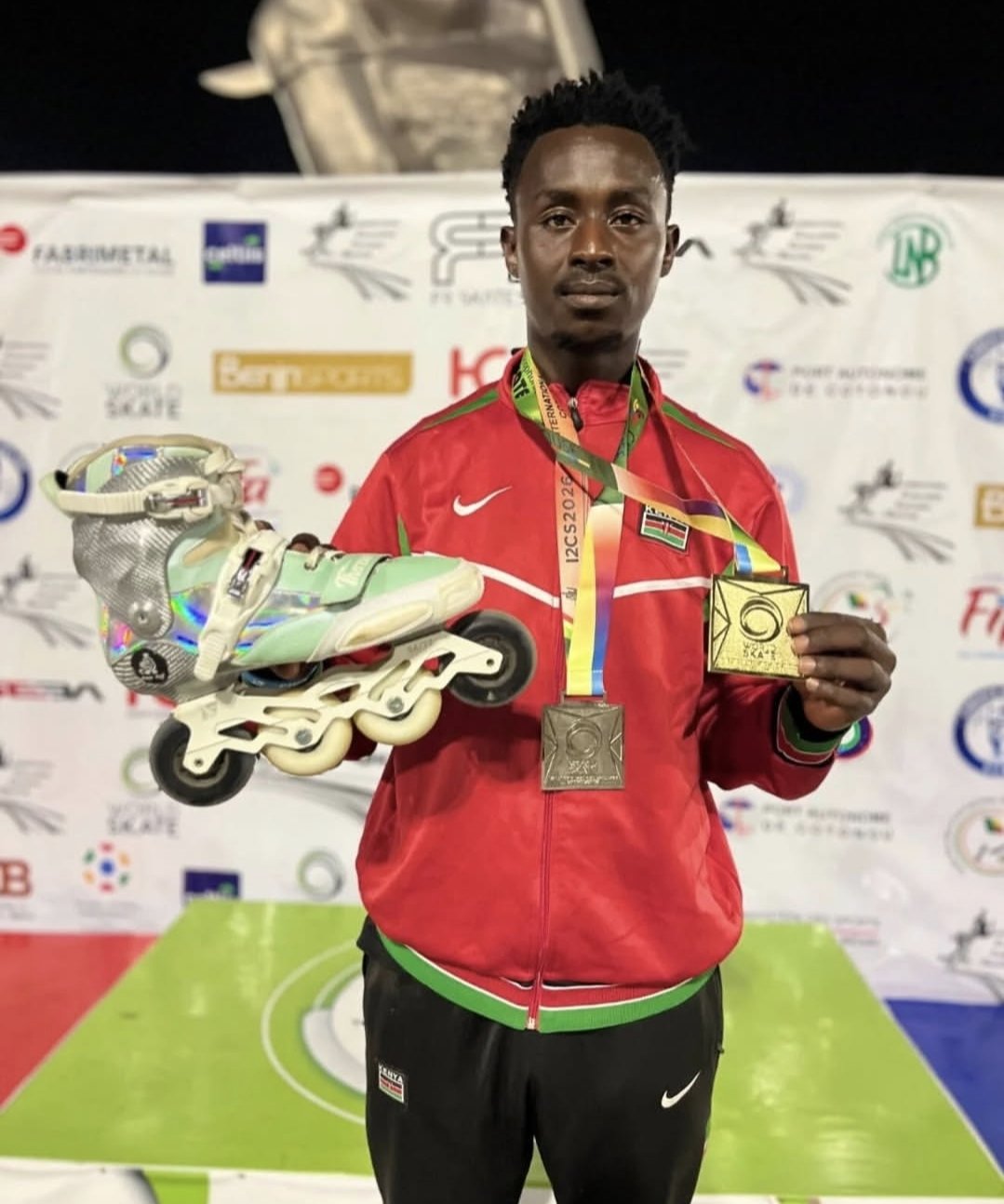
On the night of April 6, 2026, as most of Nairobi settled in for sleep, a young man dressed in his national team kit dragged his skating equipment through the gates and hopped onto a matatu heading for Jomo Kenyatta International Airport. Kelvin Kiarie, 26-year-old inline skating champion, structural engineer, and father, could not afford an Uber. He had Ksh left in his pocket, a 3 a.m. flight to Cotonou, Benin, and a dream to represent Kenya at the International Skating Challenge. There was no government official to see him off. No federation administrator holding his boarding pass. Just Kelvin, his family’s voices calling goodbye from the roadside, and the city rolling past him in the dark.
He won gold.
“I left at 10 pm and arrived very early, because otherwise I would not find a matatu to the airport at 2am. Regardless, we won.” — Kelvin Kiarie
BACK-TO-BACK GOLD FOR AN UNBACKED CHAMPION
The Benin performance — gold in freestyle battle and silver in classic slalom — was just the opening act. In May 2026, Kiarie travelled to Cairo, Egypt, for the African Skating Championships, this time with Kenyans in the diaspora promising to fill the stands. He arrived safely, moved by the hundreds of messages that had poured in after his story went viral. On May 3, he stood at the top of the podium once again, a gold medalist, a continental champion, and one of the most celebrated sporting figures of the year—self-funded, self-coached, and self-reliant throughout.
President William Ruto publicly congratulated Kiarie after the Cairo victory, calling his journey an inspiration to the nation. It was a warm message, warmly received — though many Kenyans noted pointedly that the congratulations came after the trophy, not before the flight.
THE FUNDING CRISIS IN KENYA’S MINORITY SPORTS
Kiarie’s story has done more than warm hearts. It has exposed a structural rot in how Kenya treats athletes who compete outside the celebrated worlds of athletics and rugby. The Ministry of Youth Affairs, Creative Economy, and Sports was allocated Ksh 13.5 billion for the 2025/26 financial year. Not a cent of it reached Kelvin Kiarie before he left for Benin. The director of sports, when asked to respond, told journalists that Kiarie had not formally applied to the ministry for support—a statement that drew scathing responses from Kenyans who noted that the burden should not fall on the athlete to navigate bureaucratic channels just to get on a plane.
Competing independently in West Africa costs between Ksh 120,000 and Ksh 180,000 in airfare alone, with accommodation and subsistence adding another Ksh 50,000 to Ksh 80,000. Kiarie covered these costs from his own earnings as a structural engineer, delaying his daughter’s school enrollment by an entire term to free up the funds. When his story broke on social media, ordinary Kenyans raised over Ksh 200,000 in M-Pesa contributions to support his Cairo trip. Citizens did what the state could not — or would not.
Kiarie has spoken about his journey with grace and humility, never bitterness. He is aware that his visibility now opens doors that were previously shut. But the broader question haunting Kenya is whether the next Kelvin Kiarie—the one who has not yet gone viral, who trains in a local park without a camera—will even make it to the starting line.
READ MORE: