As fuel prices hit KSh 206.97 per litre at midnight on Wednesday, Kenya now sits far above every neighbour in the region. Angry citizens are threatening to march on State House.
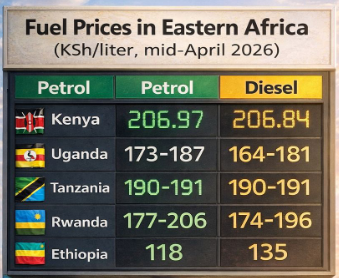
⛽ Fuel Prices in East Africa (2026, Approx.)
🇰🇪 Kenya | Petrol: KSh 206.97 | Diesel: KSh 206.84
🇺🇬 Uganda | Petrol: 190 – 200 | Diesel: 175 – 195
🇹🇿 Tanzania | Petrol: ~190 – 195 | Diesel: ~185 – 190
🇷🇼 Rwanda | Petrol: ~160 – 170 | Diesel: ~155 – 165
🇸🇴 Somalia | Petrol: ~145 – 150 | Diesel: ~140 – 145
🇪🇹 Ethiopia | Petrol: ~110 – 120 | Diesel: ~105 – 115
All prices in KSh equivalent per litre. Source: Regional fuel data, April 2026.
At the stroke of midnight on Wednesday, Kenyans who were already stretched thin by the cost of living woke up to yet another gut punch — fuel prices revised upward, cementing Kenya’s position as the most expensive country for petrol in the entire East African region.
Petrol now costs KSh 206.97 per litre and diesel KSh 206.84 per litre — more than KSh 7 above Uganda, nearly KSh 17 above Rwanda, and a staggering KSh 87 more per litre than Ethiopia. The rising fuel prices hit Kenyans like a freight train, especially in a country where millions rely on matatus, bodabodas, and small businesses to survive.
“Ethiopia pays KSh 110. We pay KSh 207. Someone must explain why Kenyans are paying nearly double for the same fuel.”
Why Are Kenyans Paying So Much More?
The high price of fuel in Kenya is not a market accident — it is a policy outcome. Analysts point to a combination of heavy fuel levies, the Petroleum Development Levy, the Road Maintenance Levy, excise duty, and VAT that pile on top of the base import cost. Every levy is added before the pump price is announced, meaning Kenyans subsidize government programmes with every litre they buy.
Additionally, the weakening of the Kenyan shilling against the dollar in recent years has made imported crude more expensive in local currency terms — a burden that lands squarely on ordinary consumers.
The real-world impact: A matatu that fills up 50 litres spends roughly KSh 4,100 more than its Rwandan counterpart. A boda boda rider filling 5 litres a day pays over KSh 30,000 extra per year compared to a Ugandan counterpart—money that could have fed a family.
Kenyans Are Not Taking It Lying Down
Social media exploded overnight as the new prices took effect. Nationwide, hashtags demanding accountability trended, and Kenyans threatened to gather at the State House, potentially marking the most significant public protest since the June 2024 Gen Z demonstrations that profoundly impacted the government.
“They raised taxes on everything — food, airtime, housing. Now fuel again. What exactly are we getting in return?” one viral post read, attracting tens of thousands of likes and shares within hours.
Opposition figures and civil society leaders have already called for emergency engagement with the government, warning that continued price hikes on essential commodities will push more households into poverty and ignite social unrest that no administration can contain.
The Numbers Don’t Lie — And Neither Do the Streets
Look at the comparison again. Somalia—a country still rebuilding after decades of conflict— has cheaper fuel than Kenya. Ethiopia, with far lower average incomes, pays barely half what Kenyans pay. Rwanda, considered one of the best-managed economies in Africa, keeps its fuel below KSh 170.
For Kenya — an economy whose size should deliver better outcomes for its citizens — these numbers are not just statistics. They are a political crisis waiting to erupt.
The government must answer one simple question: if every neighbour can keep fuel affordable, why can’t we?
As Wednesday turns to Thursday and Kenyans head out to work, run businesses, and ferry their children to school, every kilometer driven is a quiet reminder that in East Africa’s most prominent economy, the ordinary citizen is paying the highest price for everything, including just getting from point A to B.
READ MORE:
Natembeya Issues Statement Over Massive Fuel Hike in Kenya
Gachagua Was Always Admiring My Body Physique Instead of Working-Ruto’s PS Reveals in a Video