Sending money home to purchase a plot in Nairobi, Kiambu, Kajiado, Nakuru, or coastal Kenya is one of the biggest financial milestones for Kenyans living in the United States, Canada, the United Kingdom, Europe, and the Middle East. However, distant transactions carry significant financial risk. Thousands of diaspora buyers are caught off-guard by hidden transaction fees or, worse, fall victim to fraudulent land deals and unregistered titles.
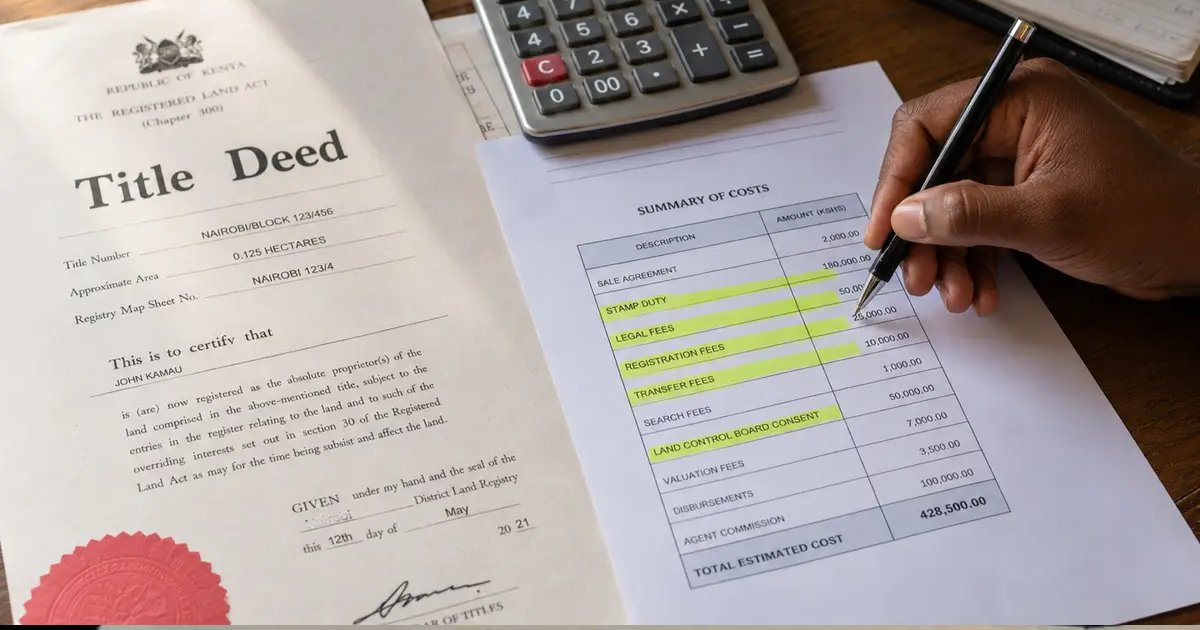
Beyond the agreed seller purchase price, acquiring a clear, legal title deed in Kenya requires paying statutory government taxes, regulated conveyancing advocate fees, surveyor beacon re-establishment charges, and official registry search fees. Under the Stamp Duty Act and the Advocates (Remuneration) Order, these costs vary depending on whether the parcel sits within an urban municipality (4% Stamp Duty) or a rural agricultural zone (2% Stamp Duty).
Furthermore, structural foundation costs vary dramatically depending on the regional soil profile—such as black cotton soil in Athi River, Kitengela, or Syokimau versus red soil in Kiambu and Ruaka.
Use our interactive Kenya Land Transfer & Construction Budget Engine below to calculate exact closing taxes, legal fees, search expenses, and foundation adjustments in seconds before transferring money to Kenya!
🏰 Kenya Land Transfer & Construction Budget Engine
Urban Town vs Rural Stamp Duty, Advocate Fees & Soil Foundation Estimator
⚖️ Need a Vetted Conveyancing Lawyer or Licensed Surveyor?
Connect directly with Law Society of Kenya (LSK) advocates and certified land surveyors for legal title transfer.
Connect With Property Lawyer on WhatsApp 📲5 Critical Steps for Diaspora Buyers to Secure Land Safely in Kenya
If you are managing a property purchase from abroad, following a strict legal protocol ensures your hard-earned foreign exchange is protected under Kenyan law:
1. Official Search via the Ardhisasa Portal
Never rely on a photocopied title deed sent via WhatsApp. Demands for digital verification mean that properties in Nairobi, Kiambu, Machakos, and major urban registries must undergo an official search certificate generation through the Ministry of Lands’ Ardhisasa digital platform. This search reveals true ownership, registered encumbrances, bank charges, or court caveats on the green card.
2. Verification of Boundary Beacons by an LSK-Vetted Surveyor
Before executing a sale agreement, hire an independent, licensed land surveyor to physically inspect the parcel and verify beacon coordinates against the Registry Index Map (RIM). This step prevents buying road reserves, riparian lands, or overlapping parcels.
3. Understanding Urban vs. Rural Stamp Duty Tax (KRA)
The Kenya Revenue Authority (KRA) and the Chief Government Valuer assess Stamp Duty based on property classification:
- 4% Urban / Municipal Rate: Applies to cities, county headquarters, and urban towns (e.g., Nairobi, Ruiru, Kikuyu, Naivasha, Nakuru, Kisumu, Mombasa, Kitengela town).
- 2% Rural Rate: Applies exclusively to agricultural or non-municipal farmland outside town boundaries.
4. Regulated Conveyancing Legal Fees
Do not pay arbitrary legal charges. Conveyancing advocates in Kenya are governed by the Advocates (Remuneration) Order. Statutory scale fees start at a minimum of 2% on the first KES 5,000,000 (minimum KES 35,000), plus 1.5% on amounts between KES 5 Million and KES 100 Million, subject to 16% VAT.
5. Budgeting for Foundation Soil Variations
Topography directly impacts your building budget after title transfer:
- Red Soil / Murram (Kiambu, Central, Western): Ideal structural stability requiring standard, low-cost strip foundations.
- Black Cotton Soil (Athi River, Syokimau, Kitengela, Joska): Expands and contracts significantly. Requires deep excavation down to hardcore rock or a reinforced raft slab, adding KES 350,000–500,000+ to early construction budgets.
- Rocky Terrain (Ngong, Kiserian): Requires mechanical pneumatic rock blasting or heavy excavator hiring before laying footings.
- Sandy Coastal Soil (Mombasa, Kilifi, Diani): Requires reinforced pillar footings and deeper piling to prevent structural settling.