
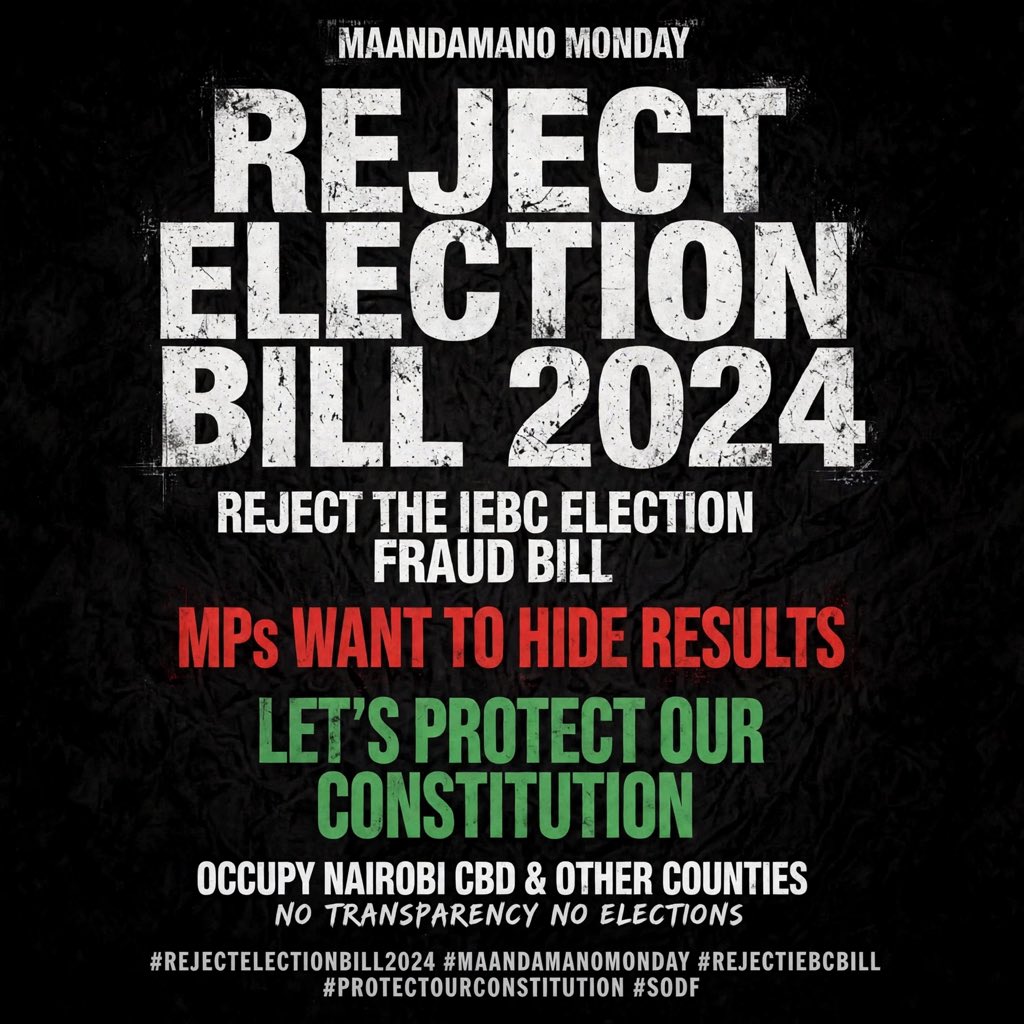
Calls for nationwide demonstrations are gaining momentum following Parliament’s approval of a controversial Bill seeking to remove the legal requirement for the Independent Electoral and Boundaries Commission (IEBC) to livestream election results as they are announced at polling stations.
Protest calls circulating online have urged Kenyans to take to the streets on Monday, October 26, to demand greater transparency in the management of elections ahead of the 2027 General Election.
The controversy follows the National Assembly’s passage of the Elections (Amendment) (No. 2) Bill, 2024, which seeks to amend Section 39 of the Elections Act and remove the statutory obligation requiring the IEBC to provide live broadcasts of results announcements at polling stations. The Bill now awaits presidential assent.
Why the Bill Has Sparked Public Outrage
Under the proposed changes, the IEBC would no longer be legally required to livestream the announcement of results at individual polling stations.
However, the legislation retains provisions requiring the commission to publish polling-station result forms on a public online portal and electronically transmit presidential election results.
The distinction has become central to the public debate, with critics arguing that removing mandatory livestreaming could make it harder for citizens, journalists and election observers to follow the tallying process as it unfolds.
The proposed amendment has consequently raised fresh questions about the safeguards available to Kenyans seeking to independently monitor the electoral process.
Protesters Demand Greater Electoral Transparency
Those calling for demonstrations on Monday are demanding that Parliament’s decision be reversed and that real-time public access to election results be protected.
Online mobilisation has focused on the importance of transparency, accountability and public confidence in the electoral process, particularly as the country prepares for the 2027 polls.
The planned demonstrations would add to growing public debate over the legal framework governing the transmission, verification and announcement of election results.
Critics have also questioned whether publishing scanned result forms after they are completed provides the same level of immediate public scrutiny as livestreaming the announcements directly from polling stations.
The debate has attracted attention from political leaders and legal experts, with opponents of the amendment warning that changes to electoral procedures must preserve the constitutional principles governing free, fair and transparent elections.
What Happens Next?
The Bill’s passage through the National Assembly does not, by itself, mean that the proposed changes have already become law. Presidential assent remains a necessary step in the legislative process.
The controversy is therefore likely to continue as Kenyans await the next developments and debate the implications of the proposed changes.
For those supporting the Monday demonstrations, the central demand is that the public should retain the ability to follow election results transparently and verify the figures announced by electoral officials.
Whether the planned protests will draw nationwide participation remains to be seen. However, the dispute over livestreaming has placed electoral transparency firmly back at the centre of Kenya’s political conversation ahead of the 2027 General Election.