
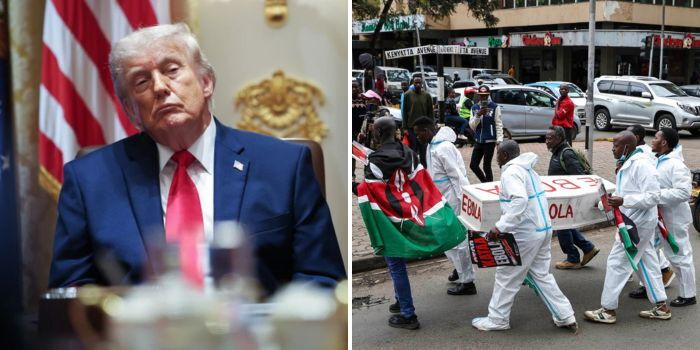
The United States government has been forced to explore other options after its plan to set up an Ebola quarantine facility in Kenya hit a wall.
The week before, the Donald Trump administration had held talks with senior Kenyan government officials and reached an agreement to establish an Ebola treatment facility. The facility was meant to treat Americans infected with the deadly virus in the Democratic Republic of Congo and the Central African Republic.
But fierce protests from Kenyans quickly changed the mood, pushing the United States to look closer to home for alternatives.
According to U.S. health officials, the country has now fallen back on a ready network of specialised treatment centres built to handle high-risk infectious diseases, Ebola included. The network is made up of 13 government-supported hospitals and academic medical centres that were put in place following the devastating 2014 West Africa Ebola outbreak, a period that exposed serious gaps in national preparedness.
Health officials say at least 10 of these facilities are fully equipped and ready to receive patients exposed to Ebola or other severe viral hemorrhagic fevers, according to Reuters. The framework has been kept alive through consistent federal funding that covers training, equipment, and isolation capacity year after year.
The U.S. Department of Health and Human Services has maintained that these hospitals remain on standby, fully capable of safely isolating and treating confirmed or suspected cases whenever the need arises.
This stance, however, sits uncomfortably alongside earlier comments from the U.S. State Department, which had insisted that no Ebola patients would be brought onto American soil. Those remarks drew sharp criticism, particularly from Kenyans who had already made their feelings on the matter very clear.