
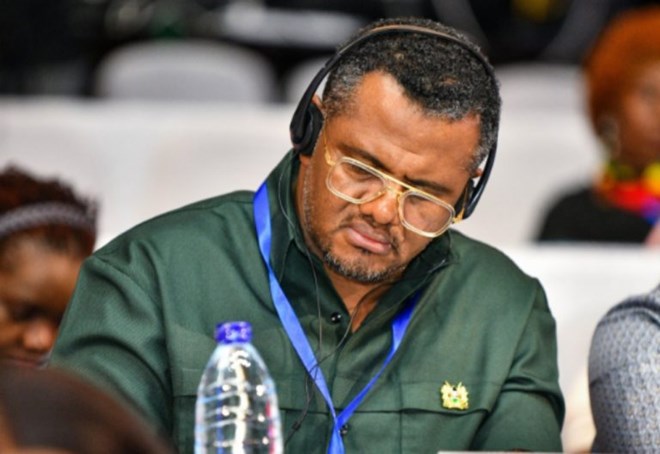
United Democratic Alliance Secretary General Hassan Omar is currently under the radar of the International Criminal Court over damning allegations that he leaked the list of witnesses who were set to testify against President William Ruto over crimes against humanity committed during the 2007 to 2008 post-election violence.
Ruto, who was then the Member of Parliament for Eldoret North, had been indicted by the Hague-based court in connection with the Kiambaa church massacre in Eldoret, one of the most haunting atrocities of that dark period, where 38 women and children were burned alive inside a church.
He was indicted alongside former President Uhuru Kenyatta, radio personality Joshua Sang, former Police Commissioner Mohamed Ali, former Head of Civil Service Ambassador Francis Muthaura, and former Cabinet Secretary Henry Kosgei. The six, who became widely known as the Ocampo Six, faced charges of participating in the organised killing of over 1,100 people and the displacement of more than half a million Kenyans during the post-election skirmishes that shook the nation to its core.
The Kenya National Human Rights Commission (KNHRC) played a critical role in safeguarding witnesses who were set to appear before the court. Some were quietly relocated abroad, to countries like Germany and the United States, while others remained under the direct protection of the KNHRC.
It is here that Hassan Omar enters the picture most chillingly. At the time, Omar was serving as a human rights lawyer and commissioner at the KNHRC. According to sources, it was Omar who betrayed those witnesses by leaking their identities to those who had every reason to silence them. What followed was nothing short of a calculated elimination. Thirteen witnesses were killed under mysterious circumstances, one by one, and with each death, the ICC’s case crumbled further. Evidence dried up, witnesses vanished, and the court found itself with nothing solid enough to proceed.
All six suspects eventually walked free, escaping the ICC noose due to the collapse of evidence and the disappearance of witnesses.
To this day, no formal investigations have been launched into how those witness identities found their way into the wrong hands. But sources are pointing firmly in one direction: at Hassan Omar, the man who is now the face and voice of the ruling party and who is alleged to have set the hitmen on a path that wiped out every living ghost of Kenya’s most painful post-election chapter.