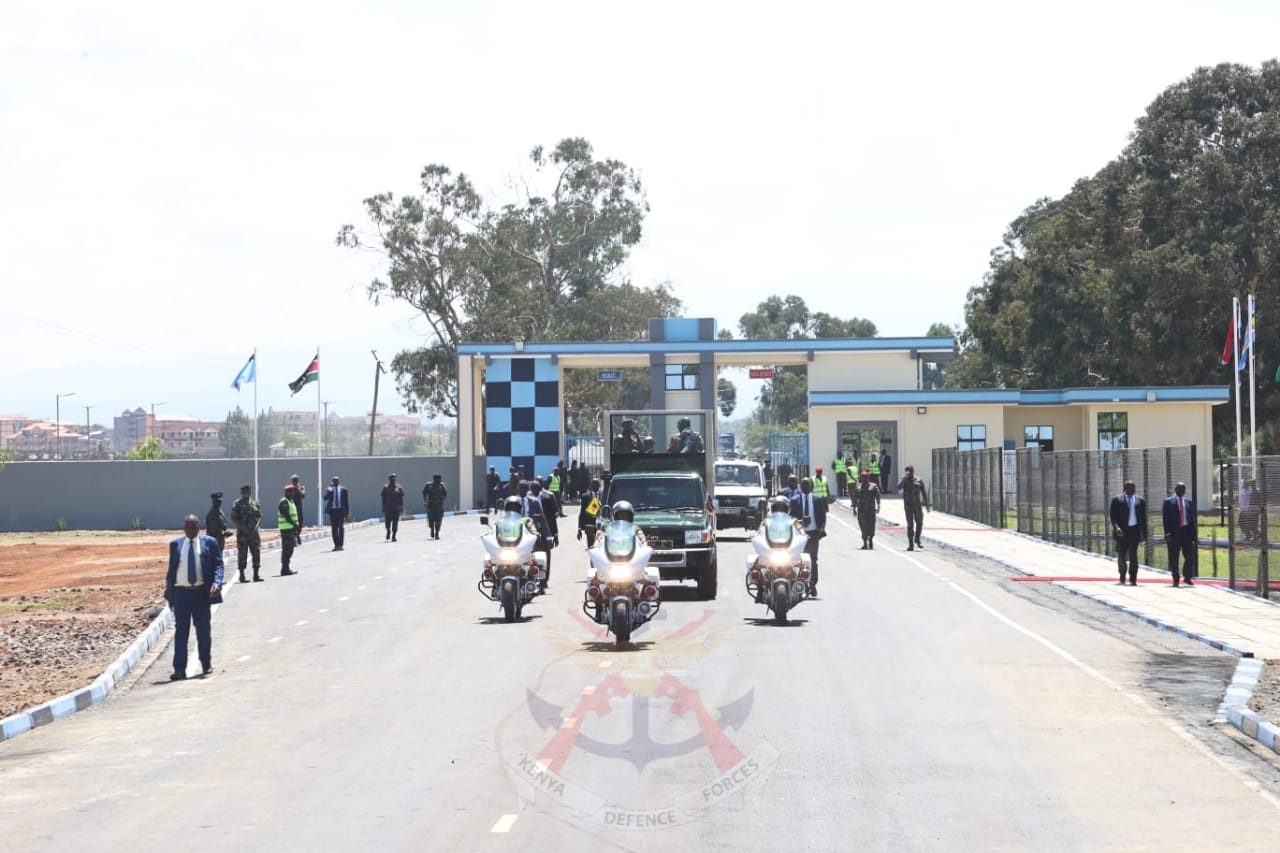
The official explanation is straightforward: Laikipia offers space, security, an airfield, and distance from Nairobi. On paper, it makes logistical sense. But logistics alone do not fully explain why Laikipia continues to emerge at the center of major American military and security initiatives in East Africa.
1. LAIKIPIA AIRBASE WAS ALREADY BECOMING A KEY U.S. OPERATIONAL HUB
Long before the Ebola facility entered public discussion, Laikipia Air Base had already attracted growing attention from U.S. military planners. In May 2025, senior AFRICOM logistics officials visited the base to discuss expanded operational cooperation, crisis-response planning, and the future role of Laikipia as a strategic logistics node. Discussions reportedly included interoperability and unmanned aerial systems training. Viewed in isolation, the visit may appear routine. Viewed alongside subsequent developments, it suggests that Laikipia was already being positioned for a larger strategic role. The Ebola facility did not emerge in a vacuum. It appeared within an environment where American military engagement was already expanding.
2. LAIKIPIA AIRBASE HAS LONG BEEN PART OF AFRICOM’S STRATEGIC MAP
Previously leaked AFRICOM planning documents identified Laikipia as a contingency location within the command’s wider African network. In military terminology, a contingency location is not simply a base on a map. It is a site that can be activated, expanded, and integrated into operations when circumstances require. This matters because it indicates that Laikipia was already included in long-term operational planning years before the current controversy emerged. The significance is not necessarily what is happening today, but the fact that the infrastructure and planning frameworks were already in place.
3. EAST AFRICA’S LARGEST MILITARY EXERCISE REVOLVES AROUND THE SAME REGION
Every year, AFRICOM conducts Exercise Justified Accord, one of its largest multinational exercises in East Africa. The 2026 exercise involved approximately 1,500 personnel operating across Kenya, Tanzania, and Djibouti. The broader Nanyuki–Laikipia area has repeatedly served as a key training and coordination environment for activities involving crisis response, humanitarian assistance, medical support, and security operations. By the time the Ebola facility was announced, the logistical networks, command relationships, transport corridors, and operational procedures associated with multinational deployments had already been tested and refined in the same region. From a planner’s perspective, this reduces risk and increases readiness.
4. THE LOCATION HAS DEEP STRATEGIC HISTORY
Laikipia’s importance predates both AFRICOM and modern Kenya. Originally developed as RAF Nanyuki during the Second World War, the facility occupied a position prized for its altitude, climate stability, open terrain, and aviation suitability. During the colonial era, it served British military purposes before eventually being transferred to the Kenya Air Force after independence. Geography has not changed. The same features that made the location attractive to British planners decades ago continue to make it attractive to modern military planners today: high elevation, favorable weather conditions, available land, secure access routes, and proximity to multiple operational theatres across East Africa.
THE BROADER QUESTION
The real question may not be why Laikipia was selected. The more important question is why the same location repeatedly appears at the intersection of military planning, crisis-response exercises, logistics infrastructure, biosecurity initiatives, and international security cooperation. Supporters see this as evidence of a strategically valuable partnership that enhances preparedness and regional stability. Critics see a gradual expansion of foreign influence into increasingly sensitive sectors of national infrastructure. Either way, Laikipia’s significance did not begin with the Ebola facility. The facility is simply the latest development in a much longer story—one that stretches through military history, regional security planning, and decades of international cooperation.