If the last time you looked into Kenya’s visa rules was before 2024, forget everything you remember — the entire system changed. Kenya no longer issues visas on arrival or the old eVisa. Every visitor now needs an approved Electronic Travel Authorization (eTA) before they even board their flight. Here’s exactly how it works in 2026, what it costs, and the mistakes that trip up first-time applicants.
The Quick Answer
Almost every non-Kenyan, non-East African visitor needs an eTA to enter Kenya — including infants. It costs $30, is applied for entirely online at the official government portal, and typically clears in 24-72 hours. There’s no visa-on-arrival fallback anymore, so skipping this step before you fly can mean being denied boarding at your home airport.
What Changed, and When
Kenya replaced its traditional visa framework with the eTA system on January 5, 2024, following a presidential directive on visa-free travel. The eTA fully replaced the old eVisa and visa-on-arrival options. It isn’t quite the “visa-free” system the announcement implied — you still need pre-approval — but the process is simpler, cheaper, and entirely digital, with no need to visit an embassy or mail in your passport.
Who Needs an eTA (and Who’s Exempt)
Kenyan citizens and East African Community (EAC) member-state citizens — Uganda, Tanzania, Rwanda, Burundi, South Sudan, and the DRC — are exempt and can travel on a national ID or passport under the EAC Common Market Protocol. Everyone else, regardless of age, needs an approved eTA. That includes:
- Every child and infant traveling, each requiring their own separate application
- Business travelers and conference attendees, not just tourists
- Anyone transiting through a Kenyan airport who plans to leave the international transit area, even briefly
If your connection stays entirely within the transit lounge and doesn’t require passing through passport control, you typically won’t need a transit eTA — but confirm this with your airline, since layover routing varies.
How to Apply — Step by Step
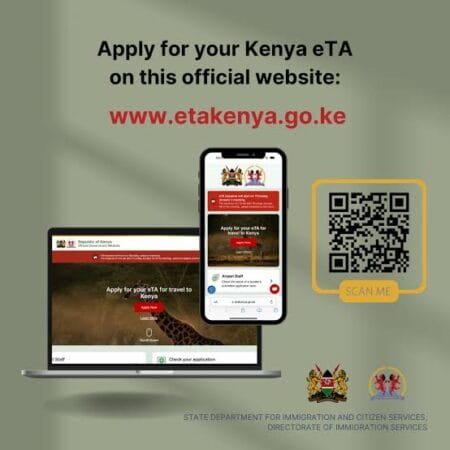
- Go to the official government portal: etakenya.go.ke. This is the only legitimate application channel. Third-party sites charging $80-150 for the same service are a common scam that catches out travelers who Google “Kenya visa” and land on a paid ad instead of the real site.
- Register with your email and verify your account through the confirmation link.
- Enter your details — full name exactly as it appears on your passport (including all middle names), passport number and expiry date, travel dates, and where you’ll be staying in Kenya.
- Upload your documents: a clear scan of your passport bio page, a passport-style photo with a white background, and proof of your return or onward flight.
- Pay the $30 fee by Visa or Mastercard. This fee is non-refundable, even if your application is rejected or you cancel your trip.
- Wait for approval — officially up to 72 hours, though many applicants hear back within a few hours. Download and keep the approval letter; you’ll need it at check-in and on arrival.
Timing: When to Apply
You can apply as early as three months before travel, but you’ll need confirmed accommodation and flight details first, so most travelers apply once those are booked. As a safety margin, apply at least 7 days before departure — airlines check for an approved eTA at check-in, and there’s no in-person fallback if something goes wrong with your application at the last minute.
What It Costs, and What You Get
The standard eTA is $30 and covers a single stay of up to 90 days, with your exact permitted stay length decided by the immigration officer at your port of entry. Some reporting also describes a multiple-entry eTA option at the same $30 fee, valid for repeat travel over an extended period — if you’re planning multiple trips to Kenya, it’s worth checking the official portal directly for the current multiple-entry terms, since these details are the kind that shift as the system matures.
Planning a multi-country safari? The East African Tourist Visa (EATV) covers Kenya, Uganda, and Rwanda under a single $100 application, with a 90-day multiple-entry stay and free border crossings between the three countries. It’s a genuinely good deal if your itinerary includes gorilla trekking in Uganda’s Bwindi or Rwanda’s Volcanoes National Park alongside a Kenyan safari — just note you must enter through whichever of the three countries issued your EATV first.
Documents and Health Requirements
Beyond your eTA, keep these in mind:
- Yellow fever vaccination certificate — required only if you’re arriving from or have transited through a yellow fever-endemic country (most of Sub-Saharan Africa, and parts of South America including Brazil, Colombia, and Peru). Direct flights from Europe, North America, or Asia are exempt from this requirement.
- No COVID-19 requirements remain — testing, vaccination proof, and quarantine rules have all been fully lifted as of 2026.
- Proof of accommodation and onward travel — the eTA system requires confirmed, not tentative, hotel or safari operator bookings, so finalize your itinerary before you start the application.
If You Need to Stay Longer
The eTA covers up to 90 days. If your plans change once you’re in Kenya, you can apply for an extension at the Department of Immigration Services (Nyayo House, Nairobi) before your authorized stay expires — overstaying is a real offense that can trigger fines or a re-entry ban. Extensions are granted at the Director of Immigration’s discretion, generally up to a maximum combined stay of 6 months. Beyond that, you’d need a different permit entirely (work, student, or residence), depending on your purpose for staying.
Common Mistakes That Cause Delays or Rejections
- Name mismatches — leaving out a middle name that appears on your passport is one of the most common causes of processing delays or border complications.
- Using third-party websites — these are not just overpriced, they can also mean handing your passport data to an unverified site. Bookmark etakenya.go.ke directly.
- Applying too early or too late — too early and you won’t have confirmed accommodation yet; too late and you risk your flight date arriving before approval clears.
- Poor quality photo uploads — heavy shadows or glare from eyeglasses in your passport photo is a common rejection trigger.
Bottom Line
The eTA system is faster and cheaper than Kenya’s old visa process, but it removes any at-the-border safety net — there’s no more visa-on-arrival to fall back on if you show up unprepared. Apply through the official portal well before your trip, double-check that your documents match your passport exactly, and you’ll clear the process in well under an hour of actual work.
If you’re also budgeting for park entry costs or checking current safety conditions before you travel, see our companion guides: Kenya Safari Park Fees 2026 and Is Kenya Safe for Tourists in 2026?
For the full trip-planning picture, see our complete Kenya Safari Travel Guide 2026.